Author: Ingrid Löwenberg | Share
Music: the most powerful weapon that does no harm
There are things no explanation can reach, but music can. I learned that while traveling alone with my guitar, at marches, in spaces shared with other artists, in the way a song can open a conversation, name a wound, or touch something that sometimes has no words. Long before I worked with methodologies or programs, I had already felt how music could connect with something deep, transform, and shift perception in a way that is entirely its own.
 When a voice takes up space
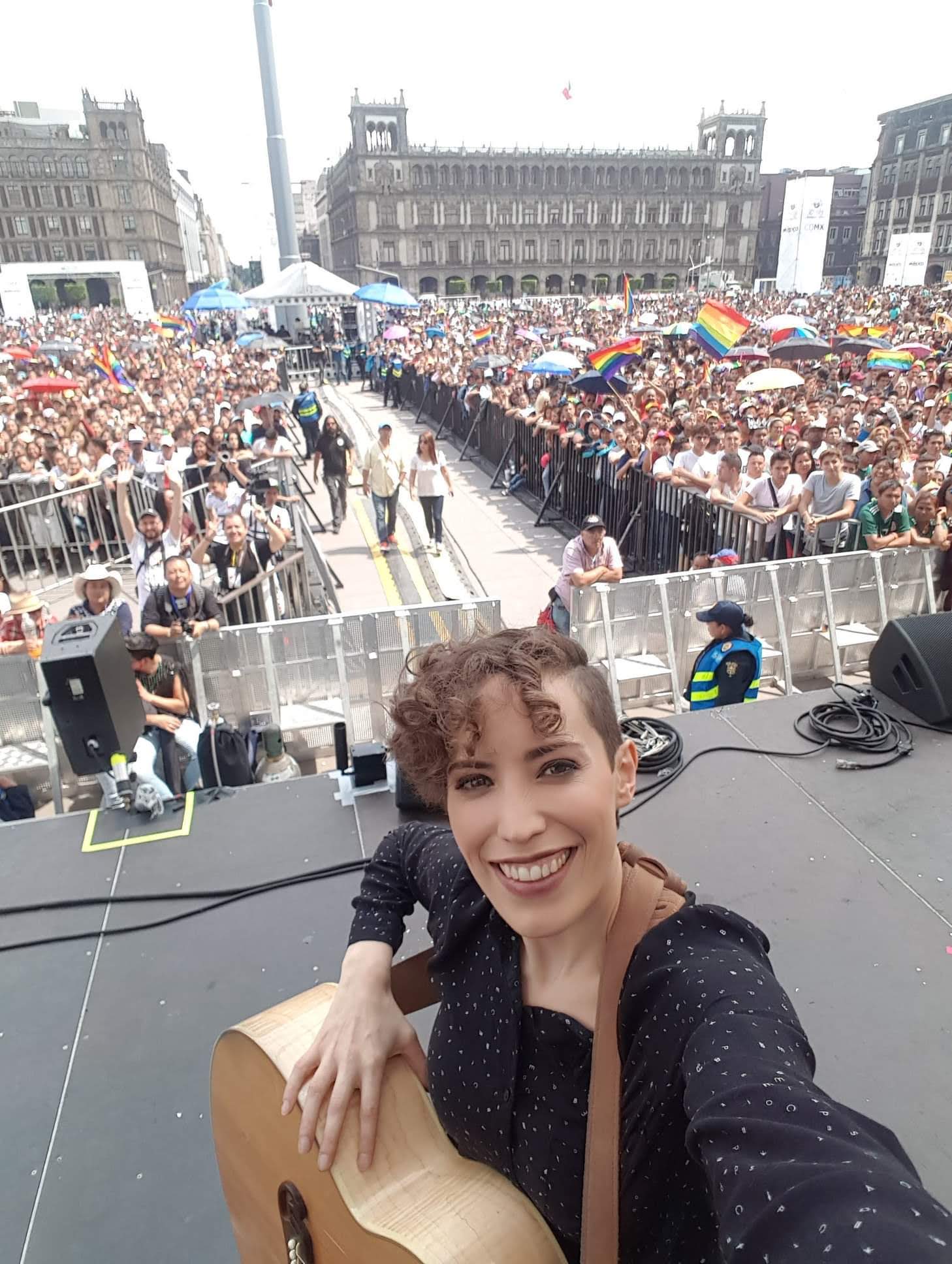
Sometimes the hardest part isn’t singing, it’s letting yourself be seen. Part of you wants to step forward, sing, and take up space, while another still shrinks into the corner, afraid of shining too bright, of unsettling people, of being judged. I loved writing, playing, and singing, but I wasn’t comfortable opening up or being vulnerable. When I was invited to perform at the LGBTTTIQ+ march in Mexico City’s Zócalo, I took it as a chance to write a song about exactly that. How many people in the community had dreamed of no longer hiding in pieces, of finally feeling free? That day I sang it to them, but I also sang it to myself. And what I discovered surprised me: being vulnerable in front of more than 100,000 people I didn’t know, but somehow recognized through a shared history, let me connect with them in a way that set me free.
When a song turns collective pain into mobilization
Sometimes a song outgrows itself and begins to carry the pain of entire communities, of a country, of the world. In Mexico, more than forty singer-songwriters came together – brought together by a great artist, Mon Laferte – to sing Canción Sin Miedo, written by my friend and colleague Vivir Quintana, at the Tiempo de Mujeres festival in Mexico City’s Zócalo. This song holds the pain that lingers in the air every day over the missing women, the femicides, tearing Mexico apart. Before we walked onto that stage, we shed our artist persona and stepped forward simply as women who live with the constant fear of not making it home, of losing the women we share our lives with, and with the determination to come together and set everything ablaze with a single song.
When a voice takes up space
Sometimes the hardest part isn’t singing, it’s letting yourself be seen. Part of you wants to step forward, sing, and take up space, while another still shrinks into the corner, afraid of shining too bright, of unsettling people, of being judged. I loved writing, playing, and singing, but I wasn’t comfortable opening up or being vulnerable. When I was invited to perform at the LGBTTTIQ+ march in Mexico City’s Zócalo, I took it as a chance to write a song about exactly that. How many people in the community had dreamed of no longer hiding in pieces, of finally feeling free? That day I sang it to them, but I also sang it to myself. And what I discovered surprised me: being vulnerable in front of more than 100,000 people I didn’t know, but somehow recognized through a shared history, let me connect with them in a way that set me free.
When a song turns collective pain into mobilization
Sometimes a song outgrows itself and begins to carry the pain of entire communities, of a country, of the world. In Mexico, more than forty singer-songwriters came together – brought together by a great artist, Mon Laferte – to sing Canción Sin Miedo, written by my friend and colleague Vivir Quintana, at the Tiempo de Mujeres festival in Mexico City’s Zócalo. This song holds the pain that lingers in the air every day over the missing women, the femicides, tearing Mexico apart. Before we walked onto that stage, we shed our artist persona and stepped forward simply as women who live with the constant fear of not making it home, of losing the women we share our lives with, and with the determination to come together and set everything ablaze with a single song.
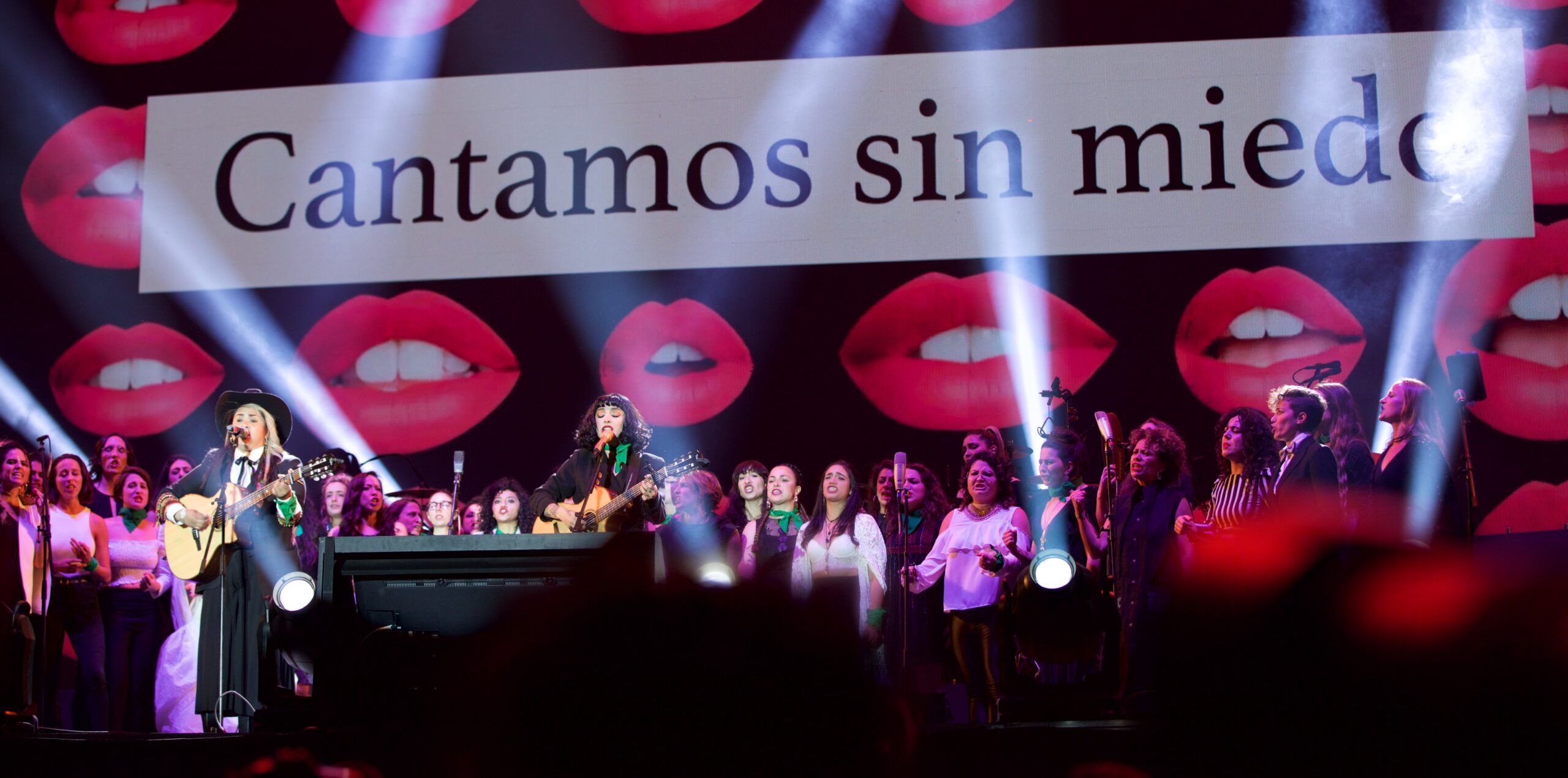 That was one week before the pandemic shut down the world. We went still, but the song didn’t. It traveled far. It echoed in homes, in women’s groups, in orchestras and embassies, reborn in different styles and languages, even as choreography. Today, it’s an anthem that takes tears, fear, and rage and turns them into strength, power, and movement. I saw firsthand how music can be one of the most powerful weapons there is, and one of the subtlest, moving through hearts and shifting perception without wounding anyone. We spent years trying to explain the pain. Then one song got through, and filled a silence that had been there a long time.
When music is a bridge
Through the pandemic, I kept showing up. I performed at online festivals and virtual serenades, and wrote custom songs for people who couldn’t be together but still wanted to reach the people they loved through music. Everything I’ve been describing brought something into focus: life takes on another dimension when what you do is also for others. While all of this was brewing inside me, I was invited to join Accountability Lab Mexico, a global translocal network working to make governance actually work for people.
“Accountability” doesn’t translate neatly into Spanish. Depending on the context, it can mean shared responsibility, transparency, or responsiveness, sometimes all three at once. These aren’t concepts that come up in most people’s everyday conversations, and they tend to feel foreign to them. Part of what Accountability Lab does is bring them closer, because when people experience these ideas as foreign, the possibility of building real shared ownership around transparency and public accountability starts to erode.
Why would they want me on the team? That was one of the first questions I asked myself. I had been close to activism, and music had taken me through experiences that mattered deeply, but I initially couldn’t see how that path fit into this sector. It wasn’t obvious to me how those two worlds talked to each other. That started to shift when I discovered that within the network, bridges already existed between music, other artistic expressions, participation, and democracy. One was a program called Rap2Rep, which later evolved into Voice2Rep and expanded to labs in Nigeria, Zimbabwe, Mali, and the Democratic Republic of the Congo. The idea was a competition for emerging artists using music to activate young people, encourage participation in democratic processes, and make concepts that usually feel abstract feel tangible and necessary, because they are, if democracy is going to mean anything. The possibility of bringing this program to Mexico lit something up in me, not just because of what the program stood for, but because of the chance to keep finding new ways to make music matter.
That was one week before the pandemic shut down the world. We went still, but the song didn’t. It traveled far. It echoed in homes, in women’s groups, in orchestras and embassies, reborn in different styles and languages, even as choreography. Today, it’s an anthem that takes tears, fear, and rage and turns them into strength, power, and movement. I saw firsthand how music can be one of the most powerful weapons there is, and one of the subtlest, moving through hearts and shifting perception without wounding anyone. We spent years trying to explain the pain. Then one song got through, and filled a silence that had been there a long time.
When music is a bridge
Through the pandemic, I kept showing up. I performed at online festivals and virtual serenades, and wrote custom songs for people who couldn’t be together but still wanted to reach the people they loved through music. Everything I’ve been describing brought something into focus: life takes on another dimension when what you do is also for others. While all of this was brewing inside me, I was invited to join Accountability Lab Mexico, a global translocal network working to make governance actually work for people.
“Accountability” doesn’t translate neatly into Spanish. Depending on the context, it can mean shared responsibility, transparency, or responsiveness, sometimes all three at once. These aren’t concepts that come up in most people’s everyday conversations, and they tend to feel foreign to them. Part of what Accountability Lab does is bring them closer, because when people experience these ideas as foreign, the possibility of building real shared ownership around transparency and public accountability starts to erode.
Why would they want me on the team? That was one of the first questions I asked myself. I had been close to activism, and music had taken me through experiences that mattered deeply, but I initially couldn’t see how that path fit into this sector. It wasn’t obvious to me how those two worlds talked to each other. That started to shift when I discovered that within the network, bridges already existed between music, other artistic expressions, participation, and democracy. One was a program called Rap2Rep, which later evolved into Voice2Rep and expanded to labs in Nigeria, Zimbabwe, Mali, and the Democratic Republic of the Congo. The idea was a competition for emerging artists using music to activate young people, encourage participation in democratic processes, and make concepts that usually feel abstract feel tangible and necessary, because they are, if democracy is going to mean anything. The possibility of bringing this program to Mexico lit something up in me, not just because of what the program stood for, but because of the chance to keep finding new ways to make music matter.
 When creating also transforms
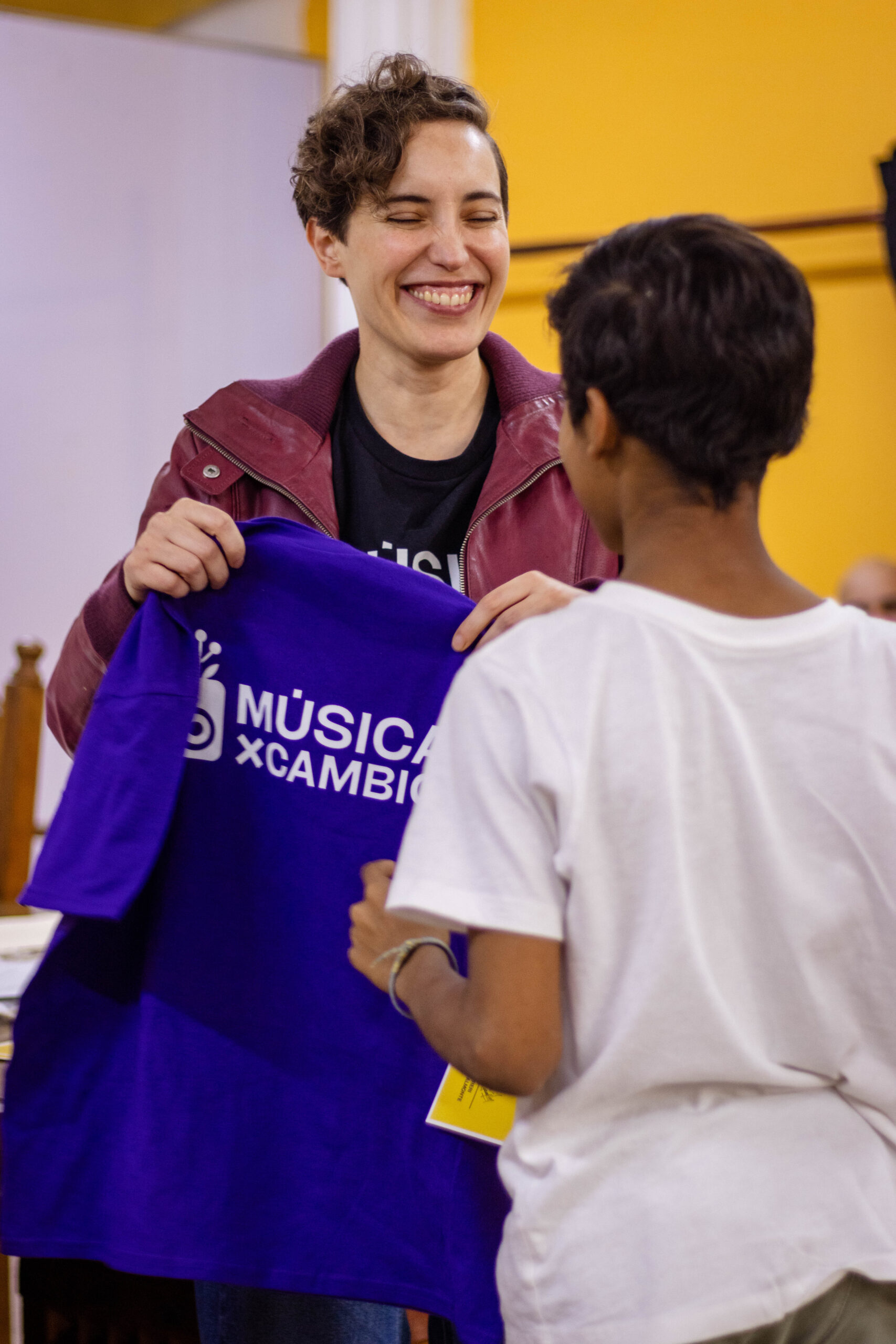
Context matters. Replicating the Voice2Rep format in Mexico was never going to be enough; what we needed was to understand how music moves in our context, in our conversations, in what matters to us, in how we build community. On March 8, after the IWD feminist march, I met with a group of friends and fellow singer-songwriters, and that’s where Leiden Gomis told me about the remarkable work she had done during the pandemic with incarcerated women, through online workshops that reached five prisons across Mexico. The idea was to collectively create testimonial songs with those women. Writing from their own experiences, they created songs that told their stories from a place that allowed them to see themselves as the owners of their own narrative, and above all, as creators. Few things feel as hopeful to me as that. From that process, Volver al corazón was born.
When a partnership opens up new possibilities
As Leiden spoke, my mind went straight to imagining what a collaboration might look like, what Voice2Rep could become in Mexico if it grew from something already alive here, something with its own momentum. And that’s how the first partnership between Leiden and Accountability Lab Mexico came to be. Our role from the Lab was focused and brief, but it mattered: we funded the printing of physical CDs to put in the hands of the women who had created the songs, and their families. We also worked to carry the conversation beyond musical spaces, opening up room to talk about the social abandonment imprisoned women face, and creating conditions for people to listen to them, without judgment, through their own songs.
When creating also transforms
Context matters. Replicating the Voice2Rep format in Mexico was never going to be enough; what we needed was to understand how music moves in our context, in our conversations, in what matters to us, in how we build community. On March 8, after the IWD feminist march, I met with a group of friends and fellow singer-songwriters, and that’s where Leiden Gomis told me about the remarkable work she had done during the pandemic with incarcerated women, through online workshops that reached five prisons across Mexico. The idea was to collectively create testimonial songs with those women. Writing from their own experiences, they created songs that told their stories from a place that allowed them to see themselves as the owners of their own narrative, and above all, as creators. Few things feel as hopeful to me as that. From that process, Volver al corazón was born.
When a partnership opens up new possibilities
As Leiden spoke, my mind went straight to imagining what a collaboration might look like, what Voice2Rep could become in Mexico if it grew from something already alive here, something with its own momentum. And that’s how the first partnership between Leiden and Accountability Lab Mexico came to be. Our role from the Lab was focused and brief, but it mattered: we funded the printing of physical CDs to put in the hands of the women who had created the songs, and their families. We also worked to carry the conversation beyond musical spaces, opening up room to talk about the social abandonment imprisoned women face, and creating conditions for people to listen to them, without judgment, through their own songs.
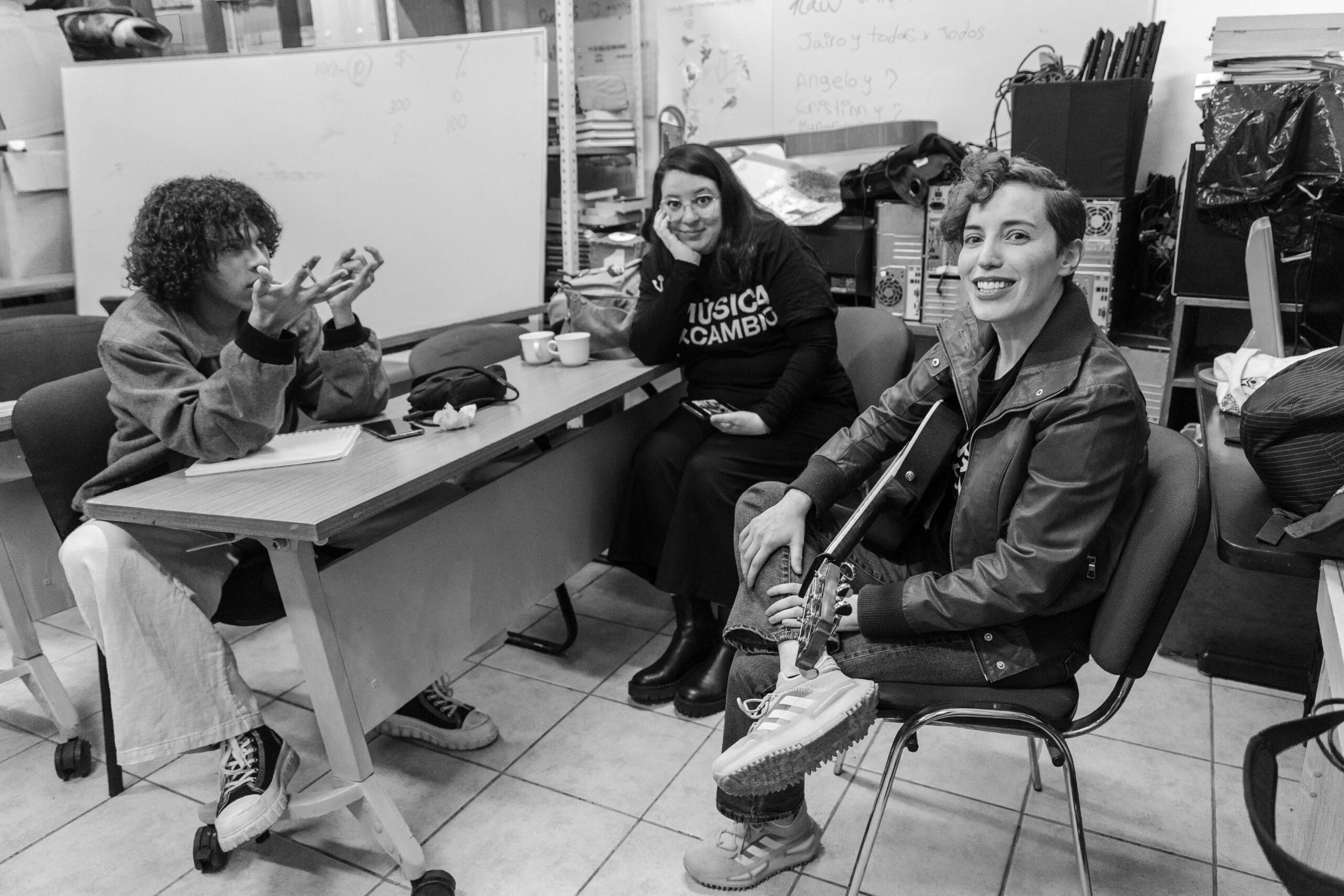 That first collaboration planted a seed that, a couple of years later, bloomed into something new. With more capacity and experience, we sat down to rethink it, not only in terms of context, but from a deeper question: how do we build something that genuinely centers the voices, stories, and lived experiences of historically stigmatized communities, at a moment when polarization is pulling everything apart? Voice2Rep had always been about activating participation and civic engagement through music. But this process pushed us toward something further: collective creation as a vehicle for expression, recognition, action, and real influence rooted in the lived experience of migrant communities. That’s where the co-creation between Leiden and Accountability Lab Mexico took shape, weaving together her participatory testimonial songwriting methodology, with our focus on strengthening civic agency – individual and collective – and building governance that works for everyone, this time through culture. From that came a new methodology: MúsicaXcambio, or Music4Change. More on that in an upcoming blog post.
There are things no explanation can reach, but music can. Perhaps because some truths must be felt before they can be understood. And that’s why I continue to believe in music as a way to accompany, to move through, to make visible, and to defend what’s important.
Recommended links
That first collaboration planted a seed that, a couple of years later, bloomed into something new. With more capacity and experience, we sat down to rethink it, not only in terms of context, but from a deeper question: how do we build something that genuinely centers the voices, stories, and lived experiences of historically stigmatized communities, at a moment when polarization is pulling everything apart? Voice2Rep had always been about activating participation and civic engagement through music. But this process pushed us toward something further: collective creation as a vehicle for expression, recognition, action, and real influence rooted in the lived experience of migrant communities. That’s where the co-creation between Leiden and Accountability Lab Mexico took shape, weaving together her participatory testimonial songwriting methodology, with our focus on strengthening civic agency – individual and collective – and building governance that works for everyone, this time through culture. From that came a new methodology: MúsicaXcambio, or Music4Change. More on that in an upcoming blog post.
There are things no explanation can reach, but music can. Perhaps because some truths must be felt before they can be understood. And that’s why I continue to believe in music as a way to accompany, to move through, to make visible, and to defend what’s important.
Recommended links
When a voice takes up space
Sometimes the hardest part isn’t singing, it’s letting yourself be seen. Part of you wants to step forward, sing, and take up space, while another still shrinks into the corner, afraid of shining too bright, of unsettling people, of being judged. I loved writing, playing, and singing, but I wasn’t comfortable opening up or being vulnerable. When I was invited to perform at the LGBTTTIQ+ march in Mexico City’s Zócalo, I took it as a chance to write a song about exactly that. How many people in the community had dreamed of no longer hiding in pieces, of finally feeling free? That day I sang it to them, but I also sang it to myself. And what I discovered surprised me: being vulnerable in front of more than 100,000 people I didn’t know, but somehow recognized through a shared history, let me connect with them in a way that set me free.
When a song turns collective pain into mobilization
Sometimes a song outgrows itself and begins to carry the pain of entire communities, of a country, of the world. In Mexico, more than forty singer-songwriters came together – brought together by a great artist, Mon Laferte – to sing Canción Sin Miedo, written by my friend and colleague Vivir Quintana, at the Tiempo de Mujeres festival in Mexico City’s Zócalo. This song holds the pain that lingers in the air every day over the missing women, the femicides, tearing Mexico apart. Before we walked onto that stage, we shed our artist persona and stepped forward simply as women who live with the constant fear of not making it home, of losing the women we share our lives with, and with the determination to come together and set everything ablaze with a single song.
That was one week before the pandemic shut down the world. We went still, but the song didn’t. It traveled far. It echoed in homes, in women’s groups, in orchestras and embassies, reborn in different styles and languages, even as choreography. Today, it’s an anthem that takes tears, fear, and rage and turns them into strength, power, and movement. I saw firsthand how music can be one of the most powerful weapons there is, and one of the subtlest, moving through hearts and shifting perception without wounding anyone. We spent years trying to explain the pain. Then one song got through, and filled a silence that had been there a long time.
When music is a bridge
Through the pandemic, I kept showing up. I performed at online festivals and virtual serenades, and wrote custom songs for people who couldn’t be together but still wanted to reach the people they loved through music. Everything I’ve been describing brought something into focus: life takes on another dimension when what you do is also for others. While all of this was brewing inside me, I was invited to join Accountability Lab Mexico, a global translocal network working to make governance actually work for people.
“Accountability” doesn’t translate neatly into Spanish. Depending on the context, it can mean shared responsibility, transparency, or responsiveness, sometimes all three at once. These aren’t concepts that come up in most people’s everyday conversations, and they tend to feel foreign to them. Part of what Accountability Lab does is bring them closer, because when people experience these ideas as foreign, the possibility of building real shared ownership around transparency and public accountability starts to erode.
Why would they want me on the team? That was one of the first questions I asked myself. I had been close to activism, and music had taken me through experiences that mattered deeply, but I initially couldn’t see how that path fit into this sector. It wasn’t obvious to me how those two worlds talked to each other. That started to shift when I discovered that within the network, bridges already existed between music, other artistic expressions, participation, and democracy. One was a program called Rap2Rep, which later evolved into Voice2Rep and expanded to labs in Nigeria, Zimbabwe, Mali, and the Democratic Republic of the Congo. The idea was a competition for emerging artists using music to activate young people, encourage participation in democratic processes, and make concepts that usually feel abstract feel tangible and necessary, because they are, if democracy is going to mean anything. The possibility of bringing this program to Mexico lit something up in me, not just because of what the program stood for, but because of the chance to keep finding new ways to make music matter.
When creating also transforms
Context matters. Replicating the Voice2Rep format in Mexico was never going to be enough; what we needed was to understand how music moves in our context, in our conversations, in what matters to us, in how we build community. On March 8, after the IWD feminist march, I met with a group of friends and fellow singer-songwriters, and that’s where Leiden Gomis told me about the remarkable work she had done during the pandemic with incarcerated women, through online workshops that reached five prisons across Mexico. The idea was to collectively create testimonial songs with those women. Writing from their own experiences, they created songs that told their stories from a place that allowed them to see themselves as the owners of their own narrative, and above all, as creators. Few things feel as hopeful to me as that. From that process, Volver al corazón was born.
When a partnership opens up new possibilities
As Leiden spoke, my mind went straight to imagining what a collaboration might look like, what Voice2Rep could become in Mexico if it grew from something already alive here, something with its own momentum. And that’s how the first partnership between Leiden and Accountability Lab Mexico came to be. Our role from the Lab was focused and brief, but it mattered: we funded the printing of physical CDs to put in the hands of the women who had created the songs, and their families. We also worked to carry the conversation beyond musical spaces, opening up room to talk about the social abandonment imprisoned women face, and creating conditions for people to listen to them, without judgment, through their own songs.
That first collaboration planted a seed that, a couple of years later, bloomed into something new. With more capacity and experience, we sat down to rethink it, not only in terms of context, but from a deeper question: how do we build something that genuinely centers the voices, stories, and lived experiences of historically stigmatized communities, at a moment when polarization is pulling everything apart? Voice2Rep had always been about activating participation and civic engagement through music. But this process pushed us toward something further: collective creation as a vehicle for expression, recognition, action, and real influence rooted in the lived experience of migrant communities. That’s where the co-creation between Leiden and Accountability Lab Mexico took shape, weaving together her participatory testimonial songwriting methodology, with our focus on strengthening civic agency – individual and collective – and building governance that works for everyone, this time through culture. From that came a new methodology: MúsicaXcambio, or Music4Change. More on that in an upcoming blog post.
There are things no explanation can reach, but music can. Perhaps because some truths must be felt before they can be understood. And that’s why I continue to believe in music as a way to accompany, to move through, to make visible, and to defend what’s important.
Recommended links
Related Content
From Our Library
Subscribe
Join our community
Subscribe for updates on new programs, stories of change, and upcoming events from across our global, translocal network.