Author: Samina Anwary | Share
Beyond “youth inclusion”: Lessons from Nepal’s Gen Z organisers
Since 2022, Gen Z movements have been at the forefront of protests across the world. Young people have taken their grievances with corruption and elite privilege, public service failure, economic insecurity, and repression to the streets, and in a short four years, five heads of state were toppled, and the definition of what constitutes civic action has expanded. And they’re not ending anytime soon or indeed at one generation. At the end of September 2026, French high school students mounted 10 days of protests against the state of the country’s education sector, while India’s youth-led movement, the Cockroach Janta Party (CJP), launched fresh protests against the government’s removal of 130 million names off the country’s voter roll.
Last September, in India’s neighbouring Nepal, former Prime Minister KP Sharma Oli was one of those five heads of state ousted following youth protests in the country. Young people galvanised around the #nepobaby social media trend criticizing the luxury lives of wealthy politicians and their families, amid rising unemployment and mass migration for opportunities outside the country. When the government banned social media platforms, frustration spilled out onto the streets as an anti-corruption protest. Police shot and killed 19 protestors on the first day, escalating tensions and turning demonstrations destructive.
In the aftermath of the protests, the Gen Z movement signed a 10-point agreement with Nepal’s interim government. It covered a broad spectrum of structural changes such as anti-corruption and transparency measures, restorative justice for protestors killed and injured as well as their families, and the establishment of a Gen Z Council.
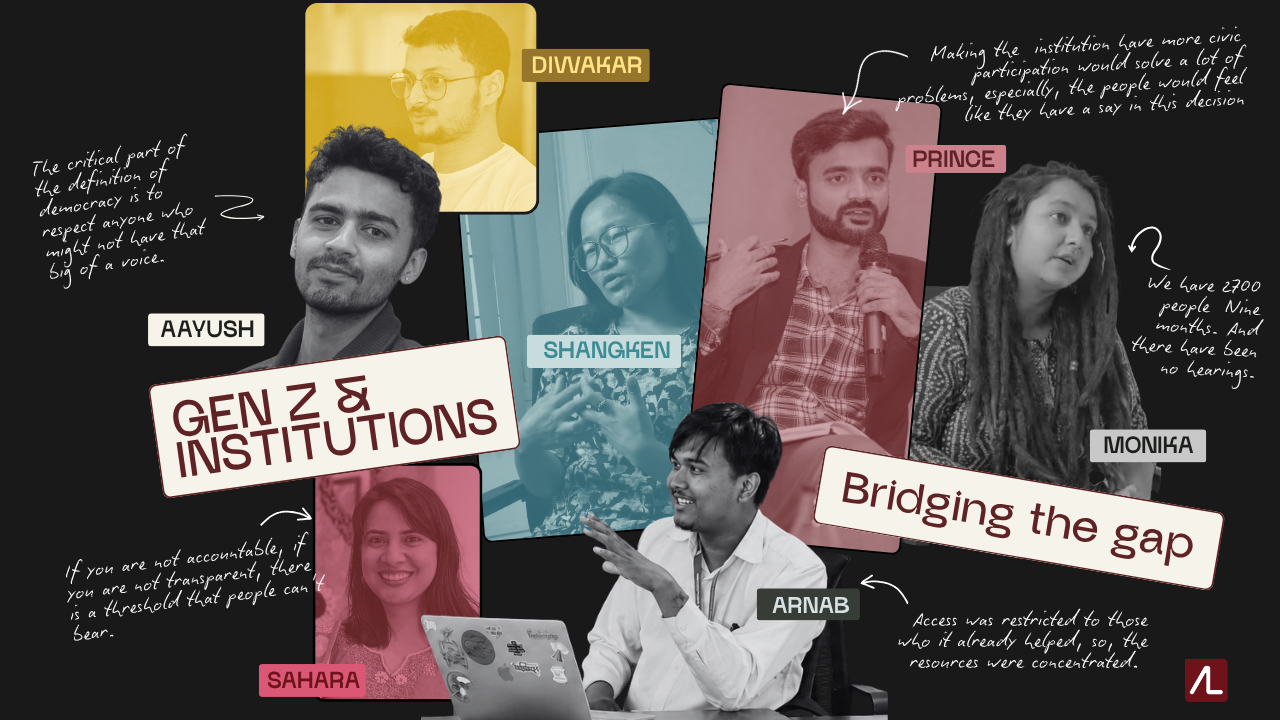
Arnab Chaudhary, an organiser who worked on the agreement, said: “We decided that there needs to be an agreement with the government. Without the agreement, our movement wouldn’t be institutionalized”.
But before the agreement could be taken to the negotiating table with the government, it needed to be negotiated between the various parties of the movement, all of whom held different political views, perceived state mechanisms differently and belonged to different social groups. Beyond a federal, secular, democratic state with proportional inclusion, all perspectives were considered and – as far as possible – included.
Monika Niroula was one of a small group of women and queer people who did the work to distill the numerous demands of various movement actors into a salient set of asks from the Nepalese government.
“There were a lot of young men who were way louder than us, who had a lot of more access and influence than we did, but wouldn’t put in the work to actually listen to everybody and write down what we actually wanted,” Monika explains.
Arnab adds that despite women being the primary demographic to synthesise, write, rewrite, and consolidate the movement’s demands, when the time came for important meetings with the Prime Minister and high ranking government officials, men overwhelmingly showed up to take those positions. Significant disparities extend beyond gender, to class, ethnicity, geography, and proximity to power and resources, and contribute to the exclusion of participants, many of whom are students, young graduates, or newly employed.
For those who; had to travel to the city centre where meetings were taking place, contribute to and manage household responsibilities, and endure being targeted by slurs based on caste and ethnicity, there was a lot to overcome to be involved.
“We wouldn’t have money to buy tea, but there were other Gen-Z friends from a slightly rich family suggesting we hold a meeting at a coffee shop. If we order a pizza, we would have to split the bill there, right? So, how would we pay? As a result, some friends would refuse to come for a meeting at such times,” Arnab explains
This distance from participation is compounded for young people outside the capital.
Diwakar Uprety founded Kayapalat, a youth-led, non-profit organization in Janakpur in Madhesh Province, 123km outside Kathmandu in what he calls the “civic desert”.
“When I sit in Madhesh and look at those young people, they are in a situation where there is no water, no food in that desert, and they have no voice,” he says.
“Support is needed to uphold the voice of the youth in those civic deserts, to bridge it to the policy level, and to bring some transformation from their voices for their benefit”.
In March this year, the Rastriya Swatantra Party (RSP), won a landslide victory of 182 out of 275 parliamentary seats, with 35-year old Balendra Shah as Prime Minister. Shah served as the independent mayor of Kathmandu from 2022 to 2026, gaining popularity for his focus on improved service delivery in the city. His election as the youngest Prime Minister in Nepal’s history was lauded as a great win following the Gen Z protests. Shah appointed nine cabinet ministers under the age of 40, bucking the trend of previous governments.
But while there are now younger people in cabinet, they were selected largely from social circles in close proximity to political resources and from higher socioeconomic backgrounds, which the 10-point agreement sought to address under point number six: Fully Proportional Inclusiveness and Participatory Representation.
“When we look at the state apparatus, whether it involves the state’s ruling structures, its political processes, or the ability to contest elections, only the upper class and upper castes have the capacity to access these spheres,” says Arnab.
“Opportunities were circulating within the same limited circle, and access was restricted to those who it already helped, so the resources were concentrated.”
“The movement is still ongoing”
The intent of the 10-point agreement is evident in its final form. It serves as a legal recording of the mammoth mobilisation of young people, a process of intentional inclusion of marginalised groups, and as a roadmap that youth and government could travel together, but movement organizers have raised red flags around the gaps in its implementation and what they call the government’s lack of ownership of the agreement.
While certain relief and compensation packages for victims have progressed, many core institutional reforms and accountability remain unrealised. Frustrations also remain around delays in the establishment of the Gen Z council – meant to be a meaningful vehicle to bring about the real policy and institutional change young people demanded through protest in the first place.
“Right now, the state is acting as per its will; the government is doing its own thing, and the protesters are following their own course,” says Arnab. “It [the state] fails to realize that they could actually be part of the solution process itself”.
A number of organisers shared that they need support in building more bridges with the government and continuing to try to ensure that the government listens and acknowledges that the 10-point agreement is a broad and widely accepted document containing the hopes, aspirations and ambitions for the country.
“We believe that the more robust the debates within a democracy, and the more we discuss issues to find solutions, the more democracy becomes institutionalized and gains further momentum,” says Diwakar.
A year after Gen Z protests in Nepal last September, new political leaders and structures have emerged, but they need to be intentionally shaped into forms that truly serve people or risk settling into the shape of the old systems they were meant to replace. Young people around the world who have been driving these movements must be part of that shaping. But participation alone is not enough. Without true intersectional inclusion, youth participation can become a tick-box exercise that leads to tokenisation, co-option, and the return of the very conditions that sparked the protests in the first place.
Related Content
From Our Library
Subscribe
Join our community
Subscribe for updates on new programs, stories of change, and upcoming events from across our global, translocal network.