Author: Shally Baloch | Share
Building Civic Resilience: From Insight to Action
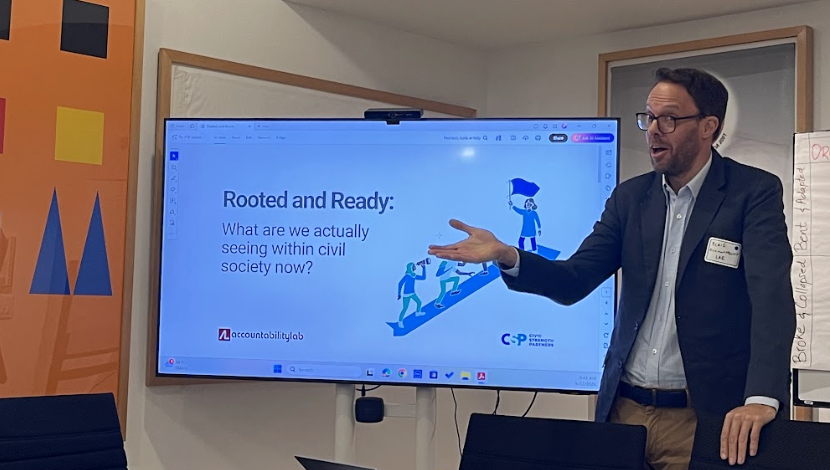
During UNGA this year, the Ban Ki-Moon Foundation, Accountability Lab, Civic Strength Partners, and UNDP convened leaders from civil society, philanthropy, and multilateral and development organizations. We met to move conversations about the future of civil society from diagnosis towards actionable steps to strengthen the ecosystems we work within and proactively build resilient civic infrastructures.
We asked three questions: what does civic resilience mean? What kind of infrastructure does it need? And what can we borrow from adjacent fields to build it? We looked at case studies to map key characteristics across three domains — organizational, financial, and relational — to understand how organizations deal with shocks, and then assessed what shocks we can already see coming to build resilience against future pressures.
Key themes
Organizational, financial, and relational factors decide whether an organization bends or breaks in the face of a shock. Many organizations may be strong in one domain while weak in the others. The most common break identified in our conversation was overdependence on a singular leader or a sole source of funding. It is diversified and multi-year funding, new income streams, and real knowledge transfer from essential staff to other team members, among other things, that allow organizations to adapt to changing realities.
Repeatedly, trust came up as key infrastructure that is foundational, not just a “nice to have.” Trust between philanthropies, organizations, and communities cannot be rushed. When organizations move too fast into parallel or redundant systems or skip trust-building entirely in formal and informal collaborations, work becomes more difficult. Funding locally led and locally legitimate organizations, peer-to-peer solidarity, and low-touch mechanisms to maintain strong relationships are critical. In a similar vein, collaboration needs its own funding and is deprioritized without a conscious effort to build it with deliberate resourcing.
There was widespread agreement that the philanthropy, CSO, and development silos must be better connected. The entire field runs as separate networks when it is — or should be — one large ecosystem. Development is a collective effort that is currently being treated as individual work. The room kept returning to the same ideas: we must bridge these networks, get them talking to each other, and build unlikely alliances across sectors that do not already collaborate by default.
Throughout the exercise, we asked participants to think proactively about how to build for predictable disruptions. Several of the disruptions named are no longer in doubt — for example, future funding cuts, climate disasters, and pandemics. Changes in funding are also affecting how much money is available, who decides where it goes, and what comes attached to it — from reporting and compliance to whose priorities the work serves. Preparedness means planning for these shifts now, as the near-certainties they are, rather than scrambling to respond to each shock or opportunity as it arrives.
From insight to architecture
Participants determined what concrete building blocks across the three domains — organizational, financial, and relational — we could already identify. Organizationally, CSOs are shrinking and roles are being redefined, with implications for knowledge retention. Financially, flows have declined, philanthropy is shifting towards new sectors, and new, non-Western funding sources are emerging. Relationally, trust is strained when networks are too informal to hold in crisis or when top-down enforced formality overtakes relationships. These relationships are further challenged by coordinated attacks and legal threats, and widening generational and ideological splits across the sector.
Building blocks
- Organizational: A one-stop resource library — templates, case studies, and a navigator tool rooted in local contexts — ecosystem mapping, and trust-based philanthropy standards with bigger multi-year grants and faster, more flexible disbursement.
- Financial: Sectoral or regional endowment funds managed by CSOs, stronger local-government coordination, financial-policy reform towards accessible systems, and deliberate alliances across sectors that do not collaborate by default.
- Relational: Intergenerational spaces and capacity building, community databases to preserve knowledge locally, and multi-stakeholder coalitions that reduce duplication through better coordination across networks.
Across all three, almost every building block is an attempt to connect something currently siloed, whether it is knowledge, money, generations, or whole sectors. The infrastructure the field wants is, in large part, connective tissue. Nearly every idea in the room, from pooled funds to shared resource libraries to intergenerational coalitions, was an attempt to link things that are currently kept apart and distinct from one another.
That is the work ahead: building the connective infrastructure for civic resilience. Civic resilience is ultimately a public good, dependent not only on strong organizations but also on connected ecosystems, enabling institutions, and meaningful opportunities for participation.
If that is work you are already doing, or want to do, we would love to hear from you!
Connect with us: [email protected] | [email protected]
Related Content
From Our Library
Subscribe
Join our community
Subscribe for updates on new programs, stories of change, and upcoming events from across our global, translocal network.