Author: Florencia Guerzovich | Share
Looking Inward: Evaluation for Questions That Matter in Civil Society
Why do we conduct evaluations in civil society: to learn, to make decisions, to be accountable, or to justify what we’ve already done? The obvious answer is usually “for all of those reasons.” But in practice, these functions don’t always coexist well. Sometimes monitoring, evaluation, and learning systems produce information, reports, and evidence, but they do not necessarily help organizations answer the questions that matter most to their work.
That tension was the starting point for the discussion “Looking Inward: Evaluation for Questions That Matter in Civil Society”, held during Global Evaluation Week, Glocal 2026. We weren’t looking to host a traditional panel or present two papers. We wanted to open an honest conversation about the elephant in the room: evaluation is taking up more and more space in Latin American civil society, but often the tools, conditions, and spaces needed to transform information and experience into useful learning for decision-making are lacking.
Civil society isn’t starting from scratch when it comes to learning. It learns every day: on the ground, in campaigns, in coalitions, during crises, in informal conversations, and in decisions made under pressure. The problem is that this learning can become fragmented: trapped in reports that go unused, teams that aren’t heard, leaders focused on different questions, communities that don’t receive feedback, or funders who request evidence at different times and in different languages.
That’s why we wanted to look inward. Not to blame organizations or to clear donors, evaluators, or intermediaries, but to understand what happens to learning when it circulates—or fails to circulate—within and among organizations. Because if MEL doesn’t help test hypotheses, adjust strategies, sustain legitimacy, and act collectively with greater coherence, it runs the risk of becoming a technical layer over problems that are deeply organizational and political.
Start with What Smells Bad
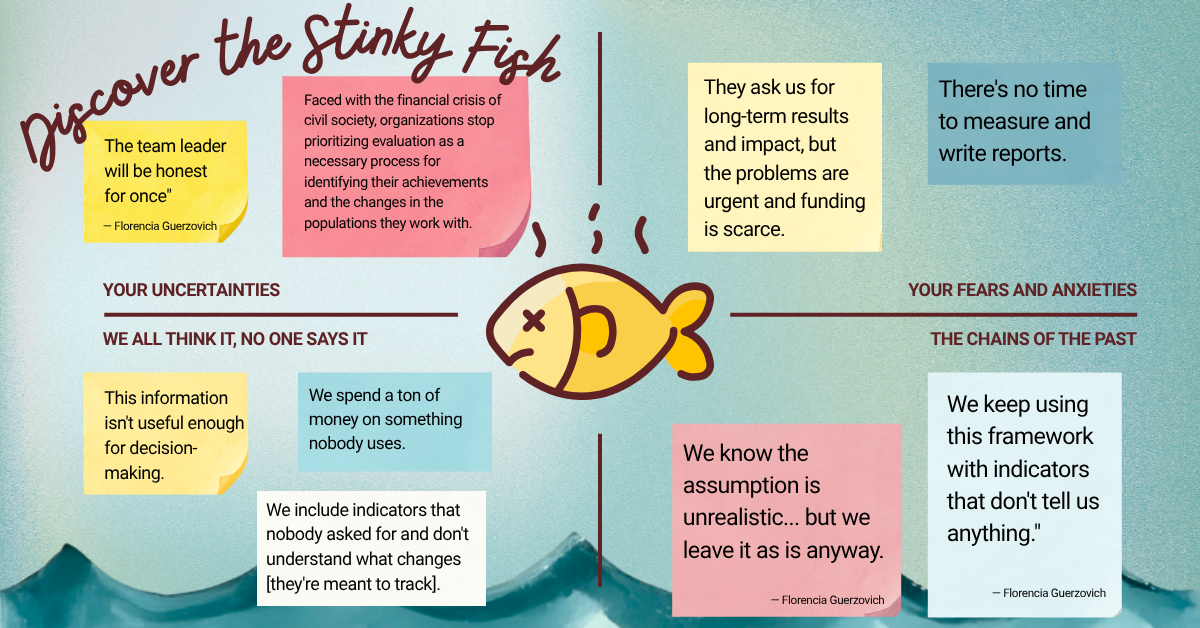
To break the ice, we invited participants to do a stinky fish: an exercise to bring to the table what usually remains beneath the surface and, if left unspoken, begins to smell bad.
The whiteboard filled up quickly. “Chains of the past” emerged: reporting the same information to different bodies, data that isn’t used to make decisions, indicators that don’t help us understand anything important, reflection meetings bogged down in red tape, unrealistic budgets that remain unchanged, pressure to showcase successes in processes that are still under construction, and the difficulty of speaking honestly about what isn’t working.
None of this came as a surprise. That’s precisely why it was important to name it.
These tensions matter especially in the current context. Many organizations are rethinking their sustainability, resilience, and legitimacy in the face of more demanding societies and more uncertain scenarios. In this environment, MEL cannot be merely a technical note or a layer of compliance. It can be a strategic capability: a way to test hypotheses, inform decisions, and circulate intelligence within and among organizations, networks, communities, funders, and intermediaries.
When that intelligence does not circulate, we lose the ability to read the context, adjust course, maintain legitimacy, and act collectively in a coherent manner.
Two entry points, one common concern
The conversation stemmed from our discussions about two recent texts that arrived at a common concern from different angles.
In “Measuring More and Learning Less”, Marco Di Natale argues that part of the field has become trapped in methodological debates that, while important, do not always address the underlying problem: the lack of structures, capacities, and standards for evaluation to generate systematic learning. Evaluating more does not necessarily mean learning better.
The other post emerged from a MEL training experience co-designed for ELAC, based on a request from Latin American human rights organizations. A paradox emerged there: many people reported knowing basic tools and feeling relatively confident using them, but those tools were not always sufficient to answer the strategic questions their organizations brought to the table.
Glocal allowed us to connect these two insights. The problem is not just that “measurement is flawed” nor merely that donors impose reporting requirements. Those issues exist and carry weight. But if the entire conversation remains focused externally—on funders, formats, or methodologies—we lose sight of an equally important layer: how learning is generated, shared, and applied within organizations and among ecosystem stakeholders.
Disconnected Worlds of Learning
The professionalization of the sector has created specialized areas—communication, administration, institutional development, MEL—that can greatly strengthen organizations. But they can also create new silos if learning remains confined to a single person or department responsible for reporting.
The problem isn’t that there’s a person responsible for MEL. The problem arises when implementation teams stop seeing themselves as part of the learning process; when leadership operates on a different level of questions; when communities are left out of the conversation about findings; or when the person drafting reports is caught in the middle, trying to translate information that doesn’t necessarily address either the team’s questions or the organization’s strategic decisions.
In many organizations, different worlds of learning coexist.
Teams in the field adapt and learn operationally as they go. Leadership operates on a more strategic, normative, or political level. The MEL, institutional development, or project management departments are often under pressure to produce reports, meet indicators, and adhere to formats. Communities and participants often generate and receive lessons through completely different channels.
Between these worlds, the intermediate layer is often weak. There is a lack of connective tissue: spaces, routines, languages, and relationships that enable the transformation of experience into shared understanding.
Looking inward does not mean blaming organizations. Nor does it mean clearing donors, intermediaries, or evaluators of their responsibility. It means taking seriously how civil society’s learning system works: what is known, who knows it, who can use it, what cannot be said, what remains undecided, and what gets lost along the way.
When learning becomes fragmented, organizations lose sight of key signals. They may repeat certain ways of doing things out of inertia, history, passion, or survival, without enough space to ask themselves whether those methods still work. An uncomfortable term appeared on the whiteboard: organizational inbreeding. Rather than an accusation, it served as a warning. Sometimes there are legitimate questions that go unasked. And if they aren’t asked, they aren’t evaluated, reported, or learned from either.
The cost isn’t just technical. It’s organizational and political. It affects the ability to adapt, sustain coalitions, defend the value of civil society, and act coherently in difficult contexts.
Intermediation also depends on learning
The conversation also helps us view intermediation in a different light. If collective action is essential, it is not enough to think of intermediaries as funding channels, project managers, or translators of requirements.
At its best, intermediation creates coherence among actors working in the same territory, between local organizations and national networks, or among local, regional, and international agendas. But that coherence does not arise on its own. It requires learning practices that allow us to pick up on signals, translate them across different worlds, preserve memory, recognize tensions, and make shared decisions.
In that sense, the MEL we need is not one that merely documents activities or produces reports. It is one that helps circulate collective intelligence within and among organizations. That is not a technocratic task. It is part of the infrastructure that enables collective action to be sustained.
How can we move forward in practice?
From the exchange, a concrete agenda emerged for building a MEL that is more useful to civil society, on which we continue to work with concrete steps.
Expand repertoires; don’t chase trends.
Many organizations don’t need more templates or trendy jargon. They need criteria for choosing tools suited to their questions, purposes, and constraints. Not all questions are answered with pre-post surveys, activity indicators, or descriptive evaluations. Questions about coalitions, legitimacy, influence, adaptation, or changes in relationships require other approaches: meaningful conversations, qualitative evidence, process mapping, rubrics, peer learning, or use-oriented evaluations.
Create a connective learning infrastructure.
It is not enough to train one person in MEL if that person is left alone to produce reports. We need to strengthen spaces where teams, leaders, communities, funders, and intermediaries can transform data, experience, and tensions into shared understanding. This may include learning meetings that go beyond mere activity updates, spaces for teams and leadership to review assumptions, mechanisms for feeding findings back to communities, or external support that bridges the gap between practice, strategy, and evidence.
Validate difficult questions.
Useful MEL must enable uncomfortable but vital questions: Are we doing the right thing? Does our coalition amount to more than the sum of its parts? What lessons from implementation aren’t making their way into the strategy? What assumptions no longer hold up? What do we report simply because it’s easy to quantify, even though it doesn’t tell us whether anything changed? These questions may be uncomfortable, but they are also the foundation of more honest learning.
Fund the journey, not just the end product.
If learning requires time, trust, translation, and support, it cannot be funded solely as a final report. Funders and partners can support conditions for learning along the way: spaces for reflection, light documentation, feedback to communities, facilitation, context-specific support, shared MEL among coalition organizations, and internal capacities to use evidence in real decisions.
Communicate learnings in languages that resonate.
One of the most powerful presentations in the session reminded us that evaluation findings shouldn’t remain solely in documents for donors or reports that circulate to distant offices. If communities, teams, and participants were part of the process, they also need ways to access, discuss, and take ownership of what was learned. Sometimes that requires different formats, different languages, and different symbols. The question is not just what evidence we produce, but who can use it and for what purpose.
The Value of Naming
The “stinky fish” exercise worked because it allowed us to name what is reported but not used, what is learned but not shared, what is known but cannot be said, and what is measured but does not necessarily matter.
This reflection does not aim to generalize to all of Latin American civil society. It draws on two articles, a training experience, an exploratory discussion, and an anonymous whiteboard filled with shared tensions. But that is precisely where its value lies: many people recognized similar problems from different parts of the field. A survey that ELAC sent to its community—the results of which it will share soon—validates this intuition from within (more on that later).
If we want a robust Latin American civil society, MEL cannot be reduced to compliance, reports, or indicators, nor confined to specialists. In a context where organizations are rethinking sustainability, legitimacy, resilience, and forms of collective action, learning better is not an afterthought. It is strategic.
The challenge is not to better communicate what we do. It is to create the conditions to better understand what we need to change, with whom we should act, and how to connect the intelligence that already exists within and among organizations.
Looking inward does not mean shutting ourselves off within the organizational sphere. It means recognizing that the capacity to learn—with honesty, method, and practicality—is also part of the infrastructure that civil society needs to remain relevant, legitimate, and capable of responding to the challenges of our time.
Related Content
From Our Library
Subscribe
Join our community
Subscribe for updates on new programs, stories of change, and upcoming events from across our global, translocal network.