Author: Accountability Lab | Share
Shifting power: Innovative approaches to grantmaking (Transcript)
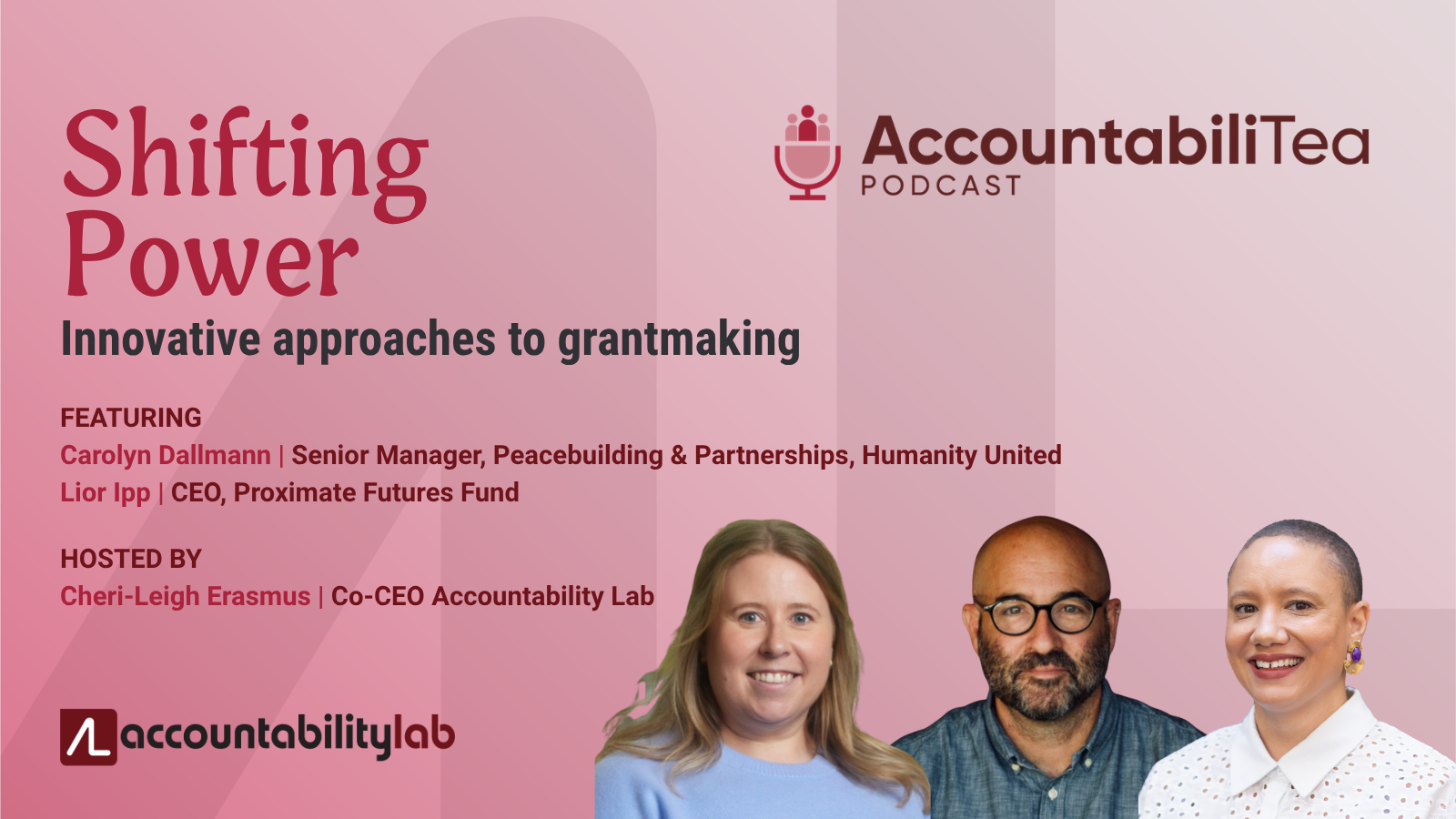
What happens when funders hand decision-making power to the people closest to the challenges they are trying to address?
In this episode of the AccountabiliTea Podcast, Accountability Lab Co-CEO Cheri-Leigh Erasmus speaks with Carolyn Dallmann of Humanity United and Lior Ipp, CEO of Proximate Futures Fund, about participatory grantmaking, proximate leadership, and what it truly means to shift power in philanthropy.
Read the full conversation below, listen to or watch the episode on Spotify, Apple Podcasts, or YouTube.
Episode produced by Naseera Noor-Mahomed, Global Communications and Marketing Manager at Accountability Lab.
Episode transcript
This transcript has been lightly edited for clarity and readability.
Lior Ipp [00:00]: What happens when you actually let go of the reins and hand over decision-making to those who know what they’re doing?
Cheri-Leigh Erasmus [00:13]: I’m so happy to be talking today with Carolyn Dallmann and Lior Ipp about innovation in grantmaking – and what that means for shifting power in social impact work. It is about getting to a place where the proximity gap between resources and the people doing exceptional work around the world is smaller, which is something we always strive for.
I think now is the moment for innovation. In many spaces, we almost have a blank slate when it comes to how we engage with people around the world.
Carolyn, I’d like to start with you. What have you learned from involving proximate actors directly in grantmaking decisions, especially through your work on the CAF? And perhaps you can tell our listeners a little about the CAF.
Carolyn Dallmann [01:05]: We are dealing with existential threats around the world that are transnational – they are no longer governed by borders. We have seen that responses cannot be governed by borders either. They have to be coordinated and strategic. We really don’t have time to waste by continuing with business as usual or assuming that one person or group has all the answers. It is time to expand the group involved in both decision-making and the work itself.
At Humanity United, we have prided ourselves on our role as a convener and on rooting our decision-making and funding closely in the knowledge of proximate actors. Through the CAF – the Collective Action Assistance Fund – we have doubled down on that approach by exploring participatory grantmaking as a way to resource movements globally.
By participatory grantmaking, we mean making grantmaking decisions participatory. Although I support the fund’s work, I am no longer the primary grantmaker. The CAF is a multi-donor, activist-led and activist-advised fund, co-created with global-majority movements and allies. It responds to something we have been saying for the past 20 years: support needs to be more local, and we have to follow the lead of people rooted in the communities we are trying to support.
The CAF does exactly that. We have a panel of incredible grantmakers who are movement actors in their own right. They applied for this role because they believed that shifting power to people closer to the work was an opportunity to influence philanthropy, as well as bilateral and multilateral donors. It demonstrates that devolving power is not inherently riskier. In fact, better decisions are possible because the people involved in making them have done the work, occupied these spaces, and been rooted in communities for much longer than people sitting in capitals in the United States or Western Europe, who have historically made those decisions.
The fund is built on the idea that donors are the best allies when they are responsive and demand-driven. Through the CAF, we are trying to support cross-issue coordination and solidarity through four main lines of effort. The first is strengthening and resourcing movements directly, which is where the participatory process plays its greatest role. We also look at strengthening the broader framework, infrastructure, and safety required for this work: Who are the players, and who needs to be involved? We give both the grantmakers and the partners we work with access to policy spaces for education, solidarity-building and accountability throughout these processes.
It has been a very rewarding experience, and listening to the panel’s decision-making each time we conduct a round of grantmaking has definitely made me a better grantmaker.
Cheri-Leigh Erasmus [04:58]: That is so refreshing to hear, Carolyn, because it feels as though the donor and grantee are learning alongside one another.
Carolyn Dallmann [05:04]: Definitely.
Cheri-Leigh Erasmus [05:04]: I also love your framing around allyship because it immediately shifts the relationship. Twenty years ago, it might have been described as a grantmaker–beneficiary relationship. Speaking instead about fellowship or allyship creates the different power structure we are seeking.
Lior, I’d love to hear how this has shown up across your career and in your current work. What have you learned from being much more proximate in your grantmaking?
Lior Ipp [05:39]: Carolyn spoke about the complexity and interconnectedness of the issues people are dealing with around the world – the polycrisis of which we are increasingly aware. Philanthropy has not evolved significantly, even though the issues have. We still have top-down, transactional relationships with the people we are trying to support. Most of us are sitting in the Global North without great insight into what the problems are or who can solve them in the Global South.
At Proximate Futures, our work over a number of years has focused on bridging that gap. We connect funders, the vast majority of whom are in the Global North, with people on the ground who are doing the work and are closest to the problems. They understand the ecosystem and local actors better, and they know who is trusted and why.
We use the wisdom, information and data we collect through peer-referral and peer-nomination processes to help funders make better-informed decisions. This also helps them understand organizations within the context of their communities and in relation to others doing similar work, rather than viewing each organization in isolation.
One of philanthropy’s biggest problems is that we conduct extensive due diligence on individual organizations but do not examine who surrounds them, who they work with, how they partner with other organizations, where their funding comes from, or how they influence the ecosystem. That information lives within communities, yet philanthropy has been extremely slow to tap into that wisdom.
Funders are often operating with blinders on because they cannot see the whole picture. The more they see and understand, the easier it is to overcome the deficit in trust and other issues preventing them from supporting more locally led organizations and the localization agenda more broadly.
We have seen excellent results—and I’m sure Carolyn can speak to this too – when funders let go of the reins and hand decision-making to people who know what they are doing. Through our work, and the work Carolyn and others are doing, we hope more funders will embrace what we see as a relatively straightforward, common-sense approach.
Cheri-Leigh Erasmus [08:28]: It feels like an absolute no-brainer. When I speak to program officers across different philanthropic organizations, this is what people strive for. They inherently believe decisions should be made closer to – or by – the people directly involved. Yet organizational constructs often make it difficult to take the steps required to move in that direction. Those structures keep the blinders on.
Carolyn, I would love to hear about the “how”. When you began approaching things differently, how did you convince the people around you? I’m sure getting everyone on board was not easy, particularly legal and compliance teams with their own concerns. What does it look like to shift internal systems so that they allow for this approach?
Carolyn Dallmann [09:26]: At the root of this is the idea of being as proximate as possible and following the lead of those most involved. There are many ways to do that, and many incredible funders are trying to strengthen this muscle. For us, it has meant participatory grantmaking, but that is only one of many possible approaches.
The CAF is Humanity United’s second foray into participatory grantmaking. Through our earlier work on forced labor and human trafficking, we worked with migrant workers and survivors to enable them to lead decision-making in support of their communities. Building on that experience gave us a framework and shared language for conversations with our legal and grantmaking teams about how to put the approach into practice globally and across themes. It allowed us to expand the range of groups we hoped to reach and engage.
For me, as Lior said, it is a no-brainer. When you explain what you want to do and why, people often get on board quickly. It is the logistics and administration that make people nervous – particularly in the current environment, where foundations supporting those advocating for fundamental freedoms, justice and democracy face heightened scrutiny in the United States and globally.
Fortunately, Humanity United is not overly conservative about taking on things that might be perceived as risks. As an institution, we decided that we were willing to devolve decision-making authority to a group of experts selected through an interview process. We wanted people who were interested in the project and had deep expertise in supporting movements across varied thematic areas – from supporting LGBTIQ rights and starting movements themselves to participating deeply in networks across regions.
Their CVs were as strong as those of any grantmaker at a foundation. That helped bring people along. We were not casually engaging people without expertise; we were actively elevating those who had it, giving them the opportunity to take on power and valuing lived experience as expertise. That principle comes from work Humanity United has been doing for well over two decades. The traditional profile of what makes a good grantmaker can be limiting.
We decided to do this as an institution and then invited other interested donors – who might not be able to implement it within their own institutions – to contribute their funding and accompany us through the process. This allows them to show their teams that the approach is not an excessively risky endeavor and does not prevent accountability or fiscal responsibility.
It turns out that much of the perceived risk is a fallacy. Now that we are about a year and a half into the process, no one is questioning the group’s decision-making. Instead, people are eager to hear the panel’s rationale and learn how members collectively reach decisions, debate with one another, and sometimes change one another’s minds.
The response has moved from, “It’s a pilot; we’ll give it a try,” to, “There is so much we can learn from these grantmakers whom we have the privilege of engaging.” Now the question is how we help them speak to more people about their work and experiences. It is rewarding to partner with the group and share learning between me, as a traditional grantmaker, and the panel members as they step into the grantmaking role themselves.
Cheri-Leigh Erasmus [14:32]: There is something powerful about reframing what counts as knowledge, who is considered a grantmaker, and who can perform that role. It is often overlooked. We speak in flowery language about lived experience, but how do we truly center it in our work? Your example brings that principle to life, Carolyn.
Lior, you have used several approaches to bring communities at the heart of challenges and solutions into grantmaking. I’d love to hear some tangible examples of how you have done that, and how you have balanced trust, accountability, and risk.
Lior Ipp [15:19]: I would echo Carolyn’s earlier point: it is a perceived risk. I do not think there is a great deal of actual risk in doing this. Distance and other biases can obstruct the relationship between funders sitting in the Global North and the work happening in communities in the Global South. If we can bridge that gap, things shift.
We have had very similar experiences when bringing funders along. They may be hesitant at first, but when they hear directly from local and proximate social entrepreneurs, nonprofit leaders, and community leaders – when they encounter their perspective, insight, and wisdom – you can almost see the shift happening as they speak. Then the funders want more of it.
We have observed an interesting process: initial hesitation and a desire to maintain control ease once funders see the level of insight and expertise held by people on the ground. From where we sit in the Global North, we do not have the same understanding or community trust. We do not grasp all the nuances of the context, the work, the possible solutions, or the different actors. Once someone is exposed to that knowledge, their perspective can change very quickly. It spreads by word of mouth as people begin to speak about the value of trusting proximate leaders.
This can also shift funders towards multi-year grants and the principles of trust-based philanthropy that people have discussed for years. There are many possible modalities. Proximate knowledge can inform decisions about where and how resources are allocated, but it can also be incorporated much earlier. If you want to understand an ecosystem better, go directly to the source. Ask people on the ground about the conditions sustaining the problem, who has the influence to change it, and what is holding it in place. Only once we understand their view of what is happening can we begin to think about how to make grants.
You can intervene at any point in the process. The wisdom and insight are available; we simply have to identify the mechanisms most appropriate for each institution. Different organizations have different tolerances for risk, so the approach will look and feel different for each one. I hope more people will come on board, because the water is safe. This should not be regarded as a particularly risky endeavor.
Carolyn Dallmann [18:26]: Cheri-Leigh, I’d like to add to Lior’s point. Shifting power in the funding space does not mean that the funder leaves. You are still a strategic partner: accompanying, learning, and providing other resources to help groups connect across spaces.
Although the structure may look different, the engagement can be more meaningful because you begin or build relationships from the premise that, as the funder, you do not know better. The people doing the work and closest to the ground know better. The question becomes: How can I use the spaces, platforms, money, and other non-financial resources available to me to support work that you already know how to do—and are doing very well?
That sometimes gets lost. People assume that localization or participatory grantmaking means there is no oversight. You still carry out due diligence. You still verify that a group is doing genuine work in a real place with real people. You simply begin from a different point, build trust, and cede power back to people who always knew they had it, but who may have been placed within a system or structure that compromised it.
At the end of the day, the people who carry the greatest risk in most places are the grantee partners with whom we work – not those of us sitting within institutions. They are responding to complex crises and opening themselves to scrutiny by accepting donor funding. The assumption that this approach is inherently risky and compromises accountability is mistaken. In many ways, it does the opposite.
Lior Ipp [20:37]: I would double down on that. If perceived risk is stopping a funder from supporting locally led organizations, there is no better way to mitigate that risk than to spend more time with those organizations and with the people who know them and understand their role within local ecosystems. That is the best way to de-risk grants.
Consider the alternative: you receive an application from an organization you have never heard of. You review it and gain some understanding of who they are, but know nothing beyond what they submitted. That seems far riskier than spending time with local experts who can speak about what the organization does, engaging the organization directly and hearing from other actors familiar with its work. That is far less risky than what traditional philanthropy often does: evaluate organizations without all the relevant information.
Cheri-Leigh Erasmus [21:42]: When those of us working in philanthropy – or in international NGOs and other organizations with relatively comfortable existences in the Global North – talk about risk, we sometimes luxuriate in it. We make our risks sound immense: compliance regimes, audits and all sorts of requirements.
But then I think about people leading movements and putting their bodies on the line. I cannot imagine that the risk I face while sitting in a relatively comfortable office in British Columbia is greater than that faced by someone doing the work on the ground, who may be actively targeted by malign governments or other actors for defending fundamental rights.
I appreciate how clearly you both distinguish between the true nature of risk and its fallacies. I’d also like to talk about narrative. How can philanthropy, civil-society partners and others actively reshape the narrative so that all actors in the social-impact ecosystem think differently about trust, risk and accountability?
Carolyn Dallmann [23:15]: Learning is key to shifting narratives. With the CAF alone, if someone asks what I am learning, I have to ask: At what level would you like me to answer?
What am I learning about resourcing movements that are often disparate, informal, or unregistered? What does it mean to work with participatory grantmakers who have lived experience? The weight of decision-making power can be heavy and emotional. These grantmakers now hold power among their peers. They may know the groups doing the work, have heard of them, or have close connections to the country or region – and they still have to say yes or no. Being closer to the work can make that decision even harder.
There is also learning to share with other donors about pooling funds or giving up decision-making power while remaining accountable within their own institutions. We can ask how to use every tool available to us. Humanity United has a 501(c)(4), for example, so how can we encourage the US government to change how it thinks about and provides resources?
How do all these interconnected streams reinforce one another and make a strong case for the work – particularly when we see how they fit together within the broader ecosystem? Sharing that knowledge with the world, through the people participating in the process, is essential.
We must also move beyond continually arguing the case. For the past 20 years, people have advocated for flexible support, general operating support, and multi-year grants where possible. I think people understand. Funders generally do not disagree with the approach, and we have a body of evidence supporting it. Yet the narrative sometimes remains stuck there.
Sharing information from real-world experiences of working differently can move people beyond debating what they should or should not do and towards action. Many donors know what to do; the challenge is taking the next step and making it actionable. That is where narrative-building is so important.
Cheri-Leigh Erasmus [26:34]: That makes a great deal of sense, Carolyn. I hope others listening will contribute to this narrative through their own learning, centering what their work teaches them and encouraging others to take a different approach.
Lior, drawing on your rich experience of shifting proximity and power, what final thoughts would you like to leave with our listeners?
Lior Ipp [26:57]: Those of us in positions of power should be evangelizing what we see and learn, including how much better our decisions become when we engage proximate leaders as allies. We should bring others along on the journey.
The best-case scenario is that more funders become willing to shift their behavior and mindset: how they fund, whom they trust, and how they allocate resources more effectively. The more of us who work from this worldview, the better off we will all be.
We need to seize every opportunity for conversations like this, for opinion pieces and for other ways of engaging funders. The more of us who do so, the more likely the approach is to be adopted widely.
One of the questions we often ask funders is: Do you want to make a grant, or do you want to solve a problem? If you want to make a grant, there are many ways to do that. If you want to solve a problem, however, that involves a much harder set of tasks. You have to roll up your sleeves, accept that it will get messy, and become comfortable with ambiguity, complexity, and the messiness of global problems.
As soon as you are ready to do that, things begin to shift. The more of us who work in this way, the more likely we are to help the people doing the real work on the ground solve some of those problems.
Cheri-Leigh Erasmus [28:45]: I love that shift from grantmaking to problem-solving. It also creates a sense that we are all knee-deep in it together, which is so important. Carolyn, do you have any final thoughts?
Carolyn Dallmann [28:56]: The forces we are confronting – whether authoritarianism, the political right, or however they manifest in different parts of the world – are highly coordinated and strategic. They share best practices constantly. We can now see the results of a coordinated, multi-decade strategy to reframe what it means to be a democracy and how democracy works for people.
There is no way to respond effectively without being equally coordinated. That requires people in positions of power, including funders, to recognize the value of our partners across global-majority countries. The Global North must see these partnerships not simply as a good or nice thing to pursue, but as the only viable approach.
Despite the halls of power we may walk through, we do not have the capacity to know how these challenges are manifesting in communities around the world at any given time. Participatory grantmaking is part of the CAF, but even more important is the coordinated work of building and strengthening an ecosystem capable of responding to these challenges.
We must acknowledge that people with specific, deeply rooted knowledge are essential at the table if we are to respond to the crises unfolding around the world. This is the moment to recognize and build on our collective opportunity to address collective challenges. We have to bring together every tool in the toolkit and be as responsive as possible.
That is our job as funders – whether in philanthropy or elsewhere. We need to root our work in the local knowledge and expertise of people doing this work every hour of every day.
Related Content
From Our Library
Subscribe
Join our community
Subscribe for updates on new programs, stories of change, and upcoming events from across our global, translocal network.