Supporting Civic Surges
How Accountability Lab is supporting Gen Z movements
The moment
Gen Z has proven it can mobilize. Since 2022, young people have driven governments from power in Nepal and Bangladesh, forced a finance bill to be withdrawn in Kenya, and driven constitutional debates from Sri Lanka to Morocco. Along the way, the definition of civic action has expanded.
What happens after these initial civic surges is far less settled.
Looking across these contexts, and at our own work in Nepal, four patterns are worth naming for us. They are not laws, and it’s important to note that none of them describes any single movement fully:
Vacuums filled badly. In Madagascar the military filled the gap. In Bangladesh, older parties were reconstituted and returned.
Protest without infrastructure. Movements that show strength on the streets often lack the evidence, legal knowledge and negotiating capacity to hold governments to account after the moment passes.
Invited in, kept out. Young leaders win an election or drive a transition, then find that the real decisions still happen in rooms they cannot participate in.
Concessions without change. A bill is withdrawn, or a promise is made, but then it’s business as usual – often within a matter of months.
If there is a common thread, it is that the harder problem is not mobilization but what comes after it.
“We sometimes look at the movement as a two-day movement. But the movement continues – that’s something that I think a lot of us don’t see or acknowledge.”
Monika Niroula, CIVIC organizer, NEPAL
What we are trying to be
We are not an INGO that arrived after Nepal’s transition with a framework to offer. Accountability Lab is a translocal network of locally registered, locally led organisations. AL Nepal had been active in the country for almost 15 years before the protests began.
We do not lead Gen Z movements. We do not speak for them. We do not want to become an institutional home that makes them dependent on us. What we try to offer is narrower:
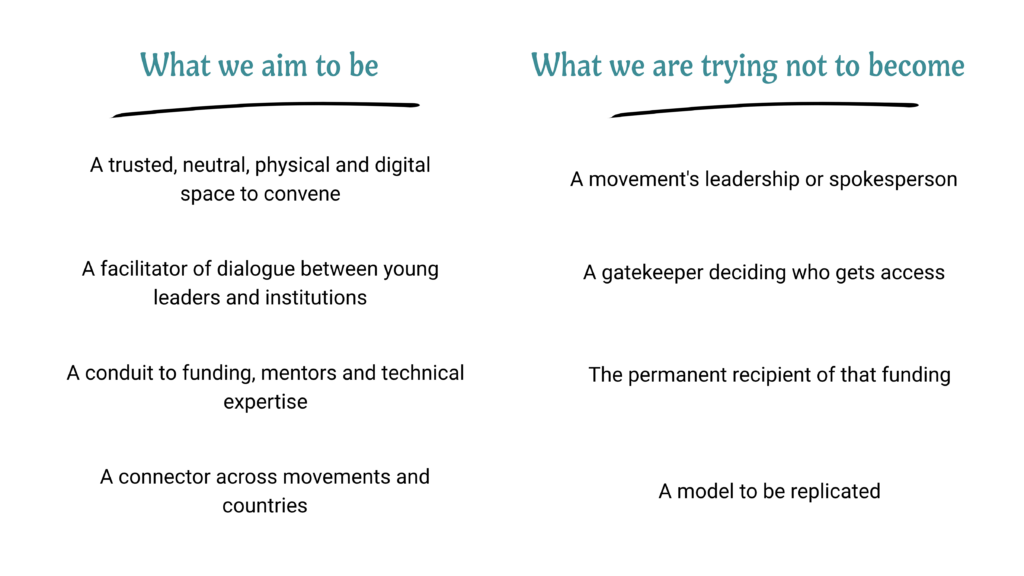
We do not always get the balance right. The line between facilitating and steering is thinner than it looks, particularly when our own staff become closely associated with a transition. We would rather name that than pretend it is solved.
The role matters because it has been left empty. As Aayush Basyal, a participant in Nepal’s movement, points out, during the People’s Movement twenty years ago civil society acted as a third party that brought political parties to the table and held government and citizens accountable to each other. That role went largely unfilled in 2025.
“Their dysfunction cost the state a lot. … the concept of civil society has to be redefined and then reintroduced to the people. It’s a very important part of how society works.”
Aayush Basyal, Gen Z movement participant, Nepal

During the protests. In September 2025 the government banned 26 social media platforms. For a generation that organises, forms opinion and shows up for each other online, this was a clampdown on the infrastructure of civic life, and it became the trigger for grievances that had been building for years around corruption, public service failure and economic insecurity.
Gen Z leaders came to AL Nepal for digital security advice, safe meeting space and emotional support, because we were already known to them. We issued a public statement in solidarity, published daily updates to counter misinformation, reached the families of those killed, and coordinated with diaspora student associations on medical treatment, repatriation and tuition.
Through the transition. We convened more than 20 civil society organisations to build a collective support mechanism for Gen Z and the transitional government. We supported the formation of the Gen Z council that negotiated the 10-point agreement signed with the government in December 2025, then ran sessions helping young leaders break down what each commitment meant in practice. Young people are now raising red flags about gaps in implementation. Whether the agreement holds is still an open question, and tracking it is part of the work.
Into reform. We joined and helped lead the working group that produced Nepal’s national anti-corruption blueprint, which now guides anti-corruption reform work in the country. We supported citizen-led transparency tools including Jawaafdehi.org, and mentored a diaspora expert network now working with ministries on policy alternatives.
Into elections. With the European Partnership for Democracy and the European Union, we ran the Youth-Led Election Monitoring initiative for the March 2026 federal elections, engaging young observers across all seven provinces and strengthening the mandate and networks of domestic observer organisations. Youth observers used digital tools to track coordinated misinformation and bot attacks, gathered community sentiment through informal peer networks, and tracked inclusion and green election indicators that standard frameworks had missed.
After the vote. Our office hosted the post-election advocacy planning session where local observation organisations came together to chart a collective path forward. On 3 April 2026 we convened Votes and Voices: Youth in Conversation, a dialogue on what participation actually felt like and where hope met resistance.
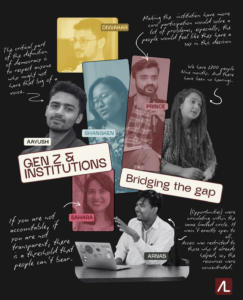
Bridging the gap: putting young people in front
Through 2026 we have been running Bridging the Gap, a campaign built around interviews with movement participants from Nepal to Kenya. It is not a retrospective. It has five aims:
- Legitimise youth-led civic action as real political participation, not a phase, a disruption, or a stand-in for institutional engagement.
- Platform young changemakers, from inside our network and well beyond it.
- Track the “after” — what happens to a movement once the protest moment ends, and whether it becomes a durable civic structure.
- Draw out practical lessons for governments, youth councils, ministries of youth and CSOs on what genuine inclusion might actually require.
- Build a resource organisers, funders and institutions can use, not just a story we tell about ourselves.
Sahara and Prince run SpeakUpNepal, a project that’s been grown and amplified during Prince’s participation in the Lab’s Civic Charge incubator for civic activists. It’s an e-petition platform that funnels citizen concerns to the relevant government departments. Departments now sometimes request petitions on specific bills to understand public opinion before proceeding. That is the bridge working.
“Freedom of opinion and expression is our fundamental right guaranteed by our Constitution. When people felt that the government was trying to restrict that right and silent their voice, it became the breaking point.” Gen Z movement participant, Nepal
“When we worked with the Department of Environment, I felt like I was talking with my colleague … like we were working together on a group project. And that should have been the norm.” Sahara, SpeakUpNepal
“The critical part of the definition of democracy is to respect anyone who might not have that big of a voice.” Aayush Basyal, Gen Z movement participant, Nepal
“It is no longer enough for youth to simply participate; we must nurture their transition from active participants to established leaders.” Min Basnet, Programme Director, National Election Observation Committee
“My perspective of elections has shifted from a purely administrative event to a human process that is dependent on respectful engagement, reliable infrastructure, honest communication and stronger civic education.” Youth election observer, 24, Gandaki Province
“They need mentorship, tools, and information to first understand these dynamics and then they can create more space for themselves.” Narayan Adhikari, Accountability Lab Nepal
What we are learning (so far)
These come from one country over one cycle.
Trust seems to work as infrastructure. It does not appear to be something that can be built during a crisis. Physical space, consistency and showing up beforehand are what made rapid support possible later.
The movement does not end when the news cycle does. Most support is designed around the protest moment. The work that decides the outcome happens afterwards, and it is the least funded part.
Participation is uneven, and proximity to main urban areas distorts it. Travel costs, connectivity and lack of exposure to civic spaces quietly filter out young people who should be central. When closeness to Kathmandu decides whose vision becomes the movement’s official story, representation suffers.
Listen first, then support what is asked for. Monika Niroula’s ask of partners is the right question, and it is a discipline rather than a slogan.
Neutral convening has limits, and we should say so. Gen Z movements are political actors. We hold the space. We do not hold a position on who should win.
What we do not know yet
We would rather publish these than pretend we have answers.
- The Gen Z council under consideration in Nepal appears to be emerging organically. We do not know whether that is replicable elsewhere, or what conditions allow such a structure to form without being imposed.
- We do not have a good answer for how to accompany movements that have deliberately rejected organizational structures and have no single interlocutor.
- Intergenerational bridging keeps coming up as necessary. We do not yet know how to do it without older allies sliding into the role of patron rather than partner.
- Micro-grants and income support work at small scale in one country. What they look like across several countries, and what funding mechanisms that needs, needs further collaborative work.
- We do not know how to demonstrate trust to funders without reducing it to a metric that damages the thing being measured.
- Where governments conceded but did not change, as in Kenya and Indonesia, we are not clear what sustained engagement should look like when the conditions that produced the protest remain intact.
What we are not doing
This is not about instrumentalising protest for donor visibility. It is not youth advisory panels without influence. It is not treating Gen Z as a single bloc with one agenda. It is not a short project deliverable.
We work alongside and through proximate organisations, not instead of them. What we can add is the cross-regional connective tissue, the fiscal infrastructure and the convening space that a single-country organization is rarely able to build alone.
Watch our series of interviews with Gen Z civic activists and reformers below.
Related Content
From Our Library
Subscribe
Join our community
Subscribe for updates on new programs, stories of change, and upcoming events from across our global, translocal network.