Author: Naseera Noor-Mahomed | Share
Extractives, revenue and community priorities in Mali
Making mining information accessible to communities and civil society has defined outcomes for how public resources are used, and also how oversight is strengthened in the extractives sector.
Publishing information about the extractive sector is important, but it can only support accountability if people can understand it, and connect it to what’s happening around them. Then, it can be used to question public institutions and private actors.
Gold has deep historical and economic significance in Mali. “It is part of Mali’s DNA and Mali’s history,” says Habibou Diaou, Country Director of Accountability Lab Mali. He points to the 14th-century ruler of the Mali Empire, whose wealth was closely tied to its gold and salt resources: “We talk about the richest man that has ever lived – Mansa Musa. He was from this part of the world.”
Today, the country’s relationship with gold raises many pressing governance questions: who benefits from extraction, how are its environmental impacts managed, and what say do communities have in decisions affecting their lives? We’re finding that stronger accountability begins with helping people access and interpret the information they need to engage with these questions.
Testing new ideas for transparency
The team connects technical information about mining to the concerns of people living near extraction sites: who operates locally, what is being extracted, where it goes, what environmental rules apply, and how revenue is managed.
A key part of this work is led by AL Mali’s accountability entrepreneurs – or accountapreneurs – as they test community initiatives that strengthen transparency and participation. Habibou explains that the accountapreneurs use community surveys, dialogues, and focus groups to identify local concerns. They also use film to document environmental impacts and collect testimony from community members. AL Mali’s research, meanwhile, draws on the experiences of civil-society organizations working in the sector.
One example is Daman Kounafoni, a digital platform developed by accountapreneur Thè Ly and Massata Hassane Bah. Their four-month pilot focused on the Sikasso region, particularly Yanfolila, gathering community experiences and concerns to inform a platform where users can access mining information, share their experiences, and discuss local issues. Extending the platform to other mining areas needs technical support and partners.
One resource informing this work is the Mali EITI report covering mining licenses, production, exports, public revenue, environmental and social impacts, subnational transfers, employment and local procurement. Mali has participated in the Extractive Industries Transparency Initiative since 2007.
Changes that governing institutions
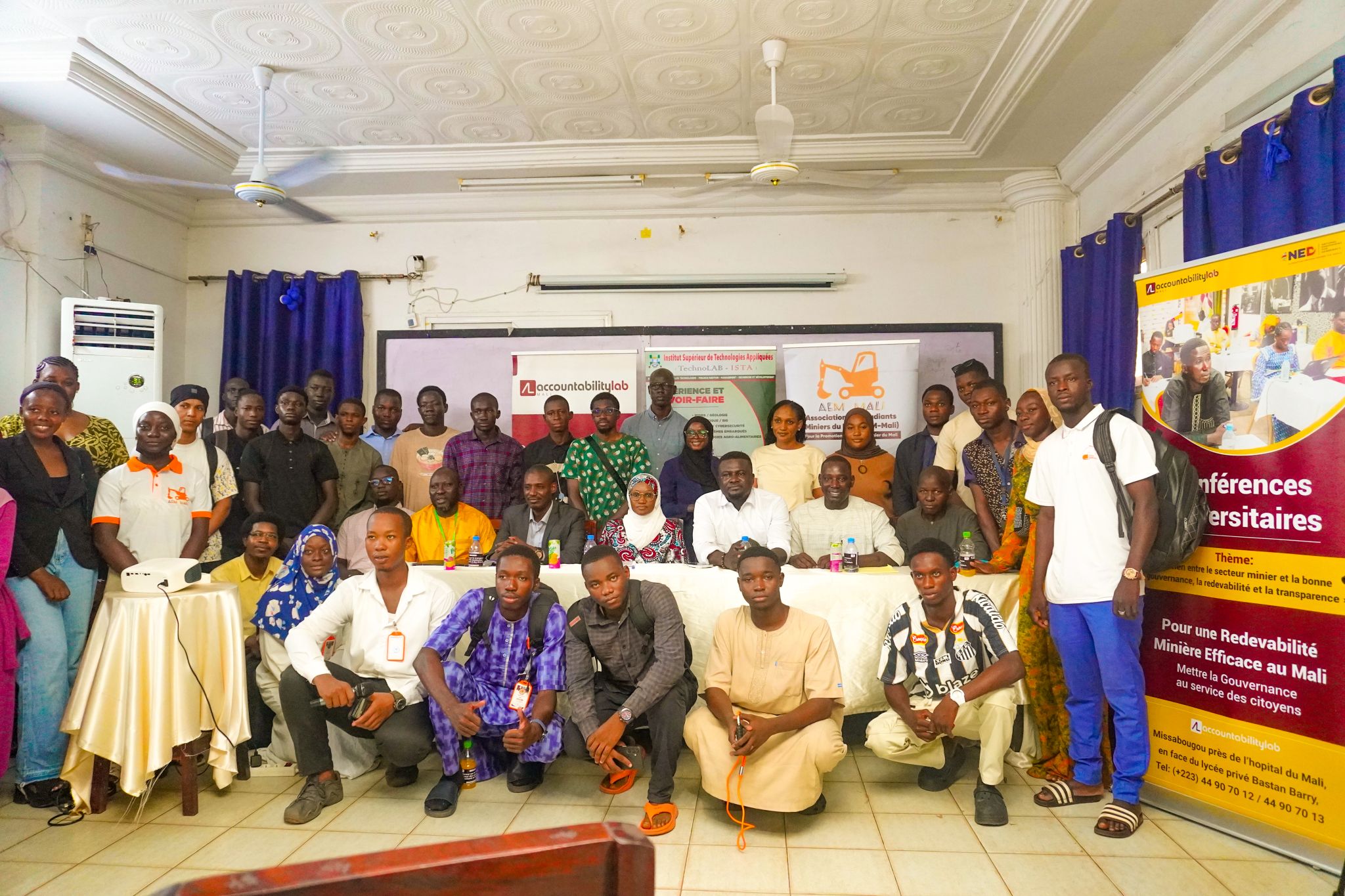
As part of the work’s broader efforts, mining communities are better able to understand the sector’s legal and regulatory rules. Al Mali connects industry experts locally during bootcamps with cohorts of young people. These sessions cover the legal framework, community rights, local content and environmental rights, helping participants develop initiatives grounded in the realities of the sector.
“Access to information is a very important right for communities that have mining activities happening around them,” Habibou says. “They must have access to information about who is there, who is working there, what is being extracted, where it is going, and how much of that resource is being reinvested into the community.”
Understanding that framework helps communities monitor environmental impacts, track resource management, and raise concerns when commitments are not met. Habibou also points to AL research into pollution at an open mining site: “We use this material to not only inform the local population about what’s happening in terms of pollution, but also do advocacy with different stakeholders.”
In Sadiola, in the Kayes region, accountapreneur Kia Sissoko’s Avenir au Féminin initiative shows how training can support participation in local decisions. Women from 10 associations discussed financial management, leadership, and community advocacy. They also developed a collective action plan which was presented to the municipal and prefectural authorities.
Changes to the institutions governing mining also matter. In March 2026, Mali’s Council of Ministers adopted draft texts to create and operate the Malian Office of Precious Substances, which is mandated to commercialize gold and other precious substances. The government’s announcement highlighted the importance of artisanal and small-scale gold mining to jobs, tax revenues, and the national economy. For communities, understanding institutional responsibilities helps them know where to seek information and raise concerns.
Habibou sees potential for the Office to improve the traceability of artisanal gold from formal sale through export, providing more reliable information about its origins and the volumes entering official markets. Better records could also give artisanal miners greater visibility in national statistics and policy, while helping communities understand the value of gold produced in their areas. This allows them to question how mining revenues support local development.
Realizing those benefits will depend on whether miners use the formal system. Procedures, prices, payment processes and purchasing points must be accessible and attractive; costly or slow processes could leave miners reliant on informal channels. Better information could support taxation and public planning, Habibou notes, but would not automatically mean additional tax revenue for municipalities.
Public access to that information will be equally important. “Collecting data does not automatically make it transparent,” Habibou cautions. He notes that the Office’s mandate to generate traceability data does not itself guarantee that all of it will be publicly available. Regular publication in accessible formats – including local-language radio, community meetings and visual communication – will be necessary for communities and civil society to use it for oversight. “Greater centralization therefore needs to be accompanied by greater openness.”
Environmental information is part of accountability
AL Mali’s analysis emphasizes that transparency includes the environmental consequences of extraction. Financial disclosures alone cannot answer communities’ questions about pollution, safeguards, or rehabilitating mining sites. Often, communities have questions about which safeguards apply, how obligations are monitored, and what arrangements exist for restoring sites after mining.
In the commune of Naréna, accountapreneur Béguelé Cissouma developed SOS Environnement Mali to document these concerns. His team surveyed residents across Naréna, Bayan, Sébécourani and Kulaka, gathering accounts of water pollution, damaged agricultural land and unrehabilitated mining sites. Alongside environmental assessments, the project established a community monitoring network with local focal points.
A central question is whether mining revenues translate into improvements for surrounding communities. The EITI report describes mechanisms through which tax revenue reaches local authorities. Under the formula it presents, 15% of the professional-license tax, known as the contribution des patentes, is allocated to the regional budget, 25% to the cercle, and 60% to the commune. The commune receives the road tax in full.
The report also compares transfers declared by regional treasuries with amounts reported by receiving local authorities. For the rural commune of Kéniéba, the regional treasury declared about 1.998 billion CFA francs in professional-license tax transfers, while the commune declared about 1.961 billion CFA francs, a difference of about 37.7 million CFA francs. The treasury also declared about 163.4 million CFA francs in road-tax transfers, while the reconciliation table shows no corresponding amount from the commune.
These differences should not automatically be read as evidence of wrongdoing. The report explains that local-authority information does not allow reconciliation at company level, and that local declarations can include payments from companies outside the extractive sector. They do, however, demonstrate the need for clear explanations of what was due, what was received and how funds were used.
Accurately interpreting financial data is another part of this work. Reconciliation compares what companies report paying with what government bodies report receiving. The ITIE Mali Steering Committee set the overall tolerance threshold for discrepancies at 2% of extractive revenue reported by government entities, equivalent to 18.4 billion CFA francs. The committee was to collect and review supporting evidence for individual discrepancies of one million CFA francs or more. The 18.4 billion figure is a reconciliation threshold; it is not a transfer to municipalities.
Figures alone cannot show whether expenditure addresses community priorities. “There needs to be more participation of the local population, to be able to follow the resources and know where the resources are going,” Habibou says. “Leaders have to be more accountable and manage the resources well.”
Alongside scrutiny of public revenue, communities also need ways to follow companies’ commitments. At Goulamina, in the Bougouni area, Dr Sidy Coulibaly’s Mines & Voix Citoyennes project trained five local data collectors and surveyed 336 residents about mining activities and commitments concerning local employment and economic support. The team combined community testimony and data visualizations in a documentary intended to support informed dialogue.
Limited access to official records meant some commitments had to be reconstructed through corroborated community testimony. The findings therefore document residents’ assessments rather than constitute an independently verified audit of company performance. Sidy’s next ambition is to develop a continuing mechanism for citizen monitoring.
Understanding artisanal mining
Artisanal and small-scale mining presents particular oversight challenges. The EITI report identifies principal gold-producing areas including Kéniéba Cercle in Kayes, Kangaba Cercle in Koulikoro, and several areas in Sikasso. It describes artisanal mining as insufficiently formalized and regulated, with workforce and production estimates varying by methodology and geographic coverage.
The sector’s scale is difficult to establish precisely. Earlier studies cited in the report estimated roughly 400,000 to 512,605 workers. A United States International Trade Administration guide published in February 2026 states that more than two million people depend on artisanal gold mining. A May 2026 Artisanal Gold Council analysis estimates that it directly or indirectly supports more than one million Malians. These figures describe different populations, including direct workers and people whose livelihoods depend on related activities. They should not be treated as interchangeable. This uncertainty underscores the need for reliable information to support oversight, environmental protection, and decisions that account for people who depend on mining.
At Touréla, in the commune of Sanankoroba, accountapreneur Ousmane Békaye Niambélé’s SOS ENFANTS project found that financial pressures and negative perceptions of schooling were contributing factors to children being present on artisanal mining sites. The findings informed awareness campaigns involving parents, teachers, and community leaders, and led to the establishment of a local committee. In the mining community of Sélingué, in the commune of Baya, Aïssata Tindé’s Her Dignity initiative addressed another barrier to participation: limited access to menstrual-health information and affordable products. The project trained 15 women to make reusable sanitary pads, held community discussions on menstrual and reproductive health, and established a community monitoring committee. It created space for public discussion of a sensitive subject, with young boys joining awareness sessions.
Building stronger civil-society oversight
Supporting collaboration among organizations working on extractive-sector governance, environmental justice, public finance and community rights is a critical role. “There is a need to bring civil-society organizations working in the governance of the extractive sector together so that they can do more advocacy together,” Habibou says. Coordination could help organizations combine their knowledge, identify shared priorities and strengthen their participation in decisions about the sector.
Reaching communities remains central to that ambition. “At the moment, it is mostly a certain level of elite who have access to that information,” Habibou says. “We need to make it available in a format that is accessible to somebody who lives in a village where extraction is going on.”
Related Content
From Our Library
Subscribe
Join our community
Subscribe for updates on new programs, stories of change, and upcoming events from across our global, translocal network.